
Challenges in the Industrial sector
Industrial manufacturers operate in fast-moving, competitive environments where uptime, quality, and service performance directly influence margin. As supply chains shift and customers expect more reliability, structural challenges - fragmented systems, legacy processes, and limited visibility - make it difficult to respond quickly and confidently.
Book a ConsultationAdministrative Challenges
Challenge 1: Fragmented Systems and Inconsistent Data
Across most industrial businesses, operational and commercial data is scattered across ERP, CRM, PLM, MES, service systems, spreadsheets, and local databases - none of which speak the same language.
Each function holds its own "source of truth," with different naming conventions, product identifiers, service codes, and update cycles. Finance tracks profitability one way, service teams track assets another way, and quality relies on its own isolated reports.
The result: Slow reporting, manual reconciliation, limited transparency into product and service performance, and a lack of trust in the numbers.
Opportunity:
A unified data architecture eliminates these silos. Automated data mapping and harmonization connect equipment data, customer records, production KPIs, warranty history, and service activity into a single operational view.
This enables: Real-time insights instead of static spreadsheets, accurate profitability and warranty exposure calculations, faster decision-making, supported by governed, reliable data. Manufacturers that centralize their data foundations typically see 50–80% reduction in reporting time, fewer errors, and better alignment across functions.


Challenge 2: Manual Reporting and Limited Real-Time Visibility
Even advanced factories still rely on manual processes - Excel files, static dashboards, and delayed monthly updates. Critical performance measures such as scrap rates, OEE, downtime, warranty costs, and parts consumption are often stitched together manually.
By the time insights reach leaders, conditions have already shifted. Production issues are found late, warranty spikes are noticed after the fact, and operational decisions rely on outdated snapshots.
Opportunity:
AI-powered reporting and automated data pipelines remove the manual effort. Live streams from machines, sensors, ERP events, and service systems feed into governed dashboards that update in real time.
Natural language interfaces let teams ask: "Show me warranty claims for Product Line B this quarter," or "What's driving downtime on Line 3 today?" This shift enables faster intervention, better resource allocation, and noticeable improvements in throughput and service responsiveness.
Challenge 3: Difficulty Aligning Strategy with Plant and Service Operations
Leadership sets clear goals - improve quality, reduce downtime, grow service revenue - but translating these goals into daily action is hard.
Production, quality, engineering, and service teams operate in different worlds, each with their own constraints. KPIs set at headquarters may not reflect local realities, and insights from the field often don't make it back into strategic planning. This creates misalignment: Conflicting priorities, duplicated efforts, unclear accountability, and uneven performance across sites or business units.
Opportunity:
AI acts as the connective layer between strategy and execution. Predictive and prescriptive analytics turn high-level goals into data-driven recommendations for plants, field service teams, and aftersales functions.
Examples include: Automated production forecasts that adjust staffing and machine schedules, quality models that highlight where investments yield the highest impact, installed base intelligence that guides proactive service planning. Digital twins allow leaders to simulate "what-if" scenarios, testing decisions before implementing them. This ensures alignment between strategic goals and day-to-day operational realities.

Operational Challenges

Challenge 1: Failure to Predict Equipment and Line Breakdowns
Unplanned downtime can cost manufacturers millions annually - lost production, missed delivery windows, and strained customer relationships.
Although machines produce valuable signals (vibration, temperature, pressure, PLC values), these data streams are often underused. Maintenance still follows static schedules, leading to reactive firefighting, over-maintenance, or early component replacements.
Opportunity:
Predictive maintenance turns maintenance into a proactive discipline. AI analyzes sensor data, historian logs, and maintenance records to detect anomalies early, well before failure impacts production.
Benefits typically include: 20–40% fewer breakdowns, longer component life, more stable production performance, lower maintenance cost per unit. When combined with automated work-order prioritization and smarter spare-parts planning, manufacturers can significantly increase overall equipment effectiveness.
Challenge 2: High Dependency on Tribal Knowledge
Manufacturing expertise often lives in the heads of a small group of experienced operators, technicians, or engineers. These individuals know how a machine should sound, how to troubleshoot a specific defect pattern, or which part is likely to fail on which customer site.
When they retire or move roles, that insight disappears. Younger teams are tech-savvy but lack decades of hands-on intuition. This creates inconsistency, variability, and slower problem resolution.
Opportunity:
AI-driven knowledge systems capture and operationalize institutional expertise. Using natural language processing and retrieval technology, manufacturers can turn technical notes, service logs, manuals, and quality records into a searchable, intelligent assistant.
Operators and technicians can ask: "What does this pressure pattern indicate?" "Has this defect happened before on this product family?" "What's the recommended fix for this alarm code?" This bridges the gap between human intuition and data-driven insight, reducing variance across shifts and sites.
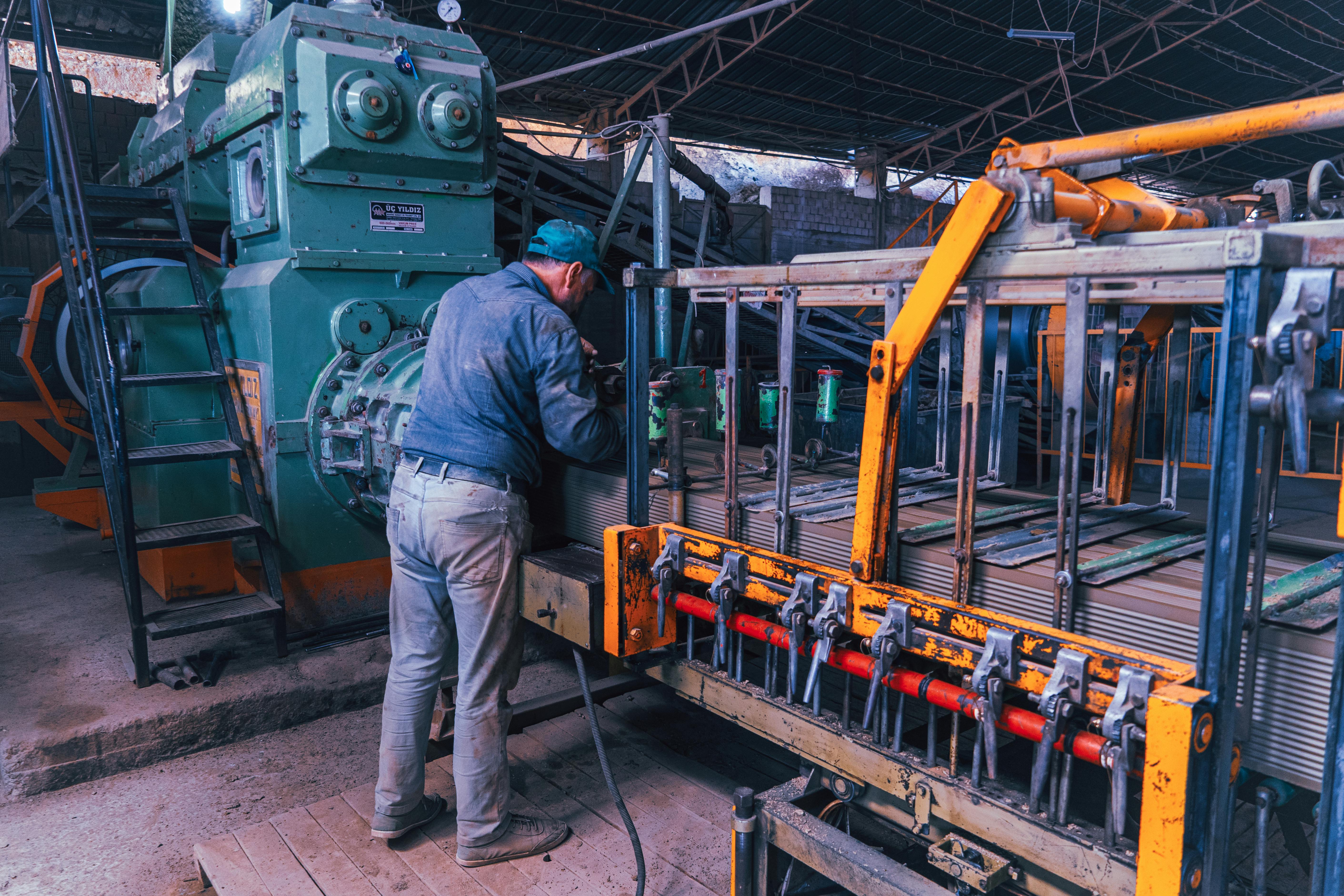

Challenge 3: Inefficient Maintenance Scheduling and Overwhelming Data Volume
Planners and supervisors juggle thousands of data points - sensor alerts, PLC logs, inspection notes, parts availability, and past work orders. Without automation, schedules default to fixed intervals or gut feeling.
This creates inefficiencies: Overlapping or unnecessary tasks, underutilized labor, wasted spare parts, difficulty prioritizing urgent issues, noise from alerts that makes important signals easy to miss.
Opportunity:
AI orchestration transforms maintenance into an intelligent workflow. By combining actual machine condition, historical failure patterns, and parts availability, AI automatically sequences and prioritizes maintenance tasks.
Typical outcomes: 10–20% higher asset utilization, fewer emergency work orders, more predictable staffing, reduction in wasted materials, clear visibility into what truly needs attention. This reduces operational stress and improves production stability.
Turn challenges into competitive advantage
Schedule a call with our industrial specialists to explore how AI, data integration, and intelligent automation can turn operational challenges into measurable improvements.
Book a Consultation